You know it when you hear it
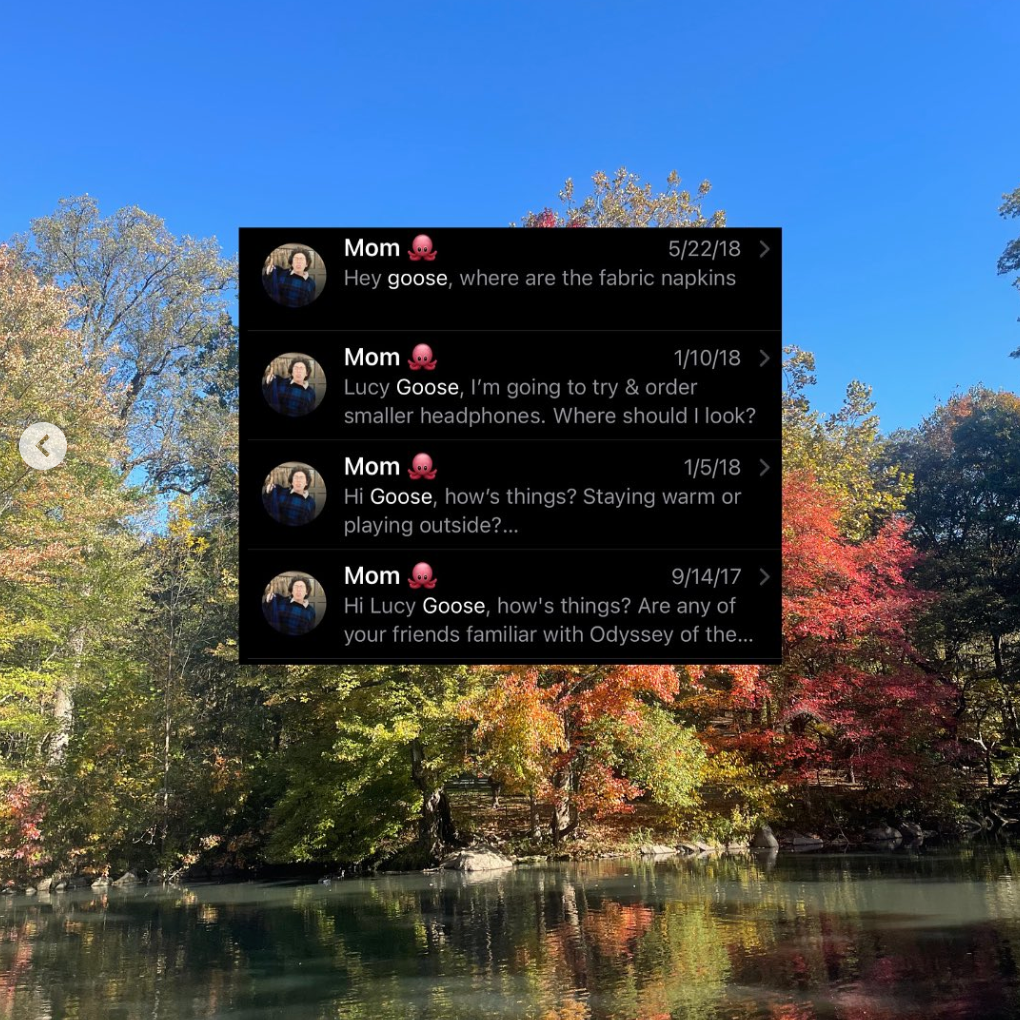
A photo of a pond in autumn, the water reflecting red, green, and orange leaves, the sky overhead a bright blue. Superimposed on the photo is a screenshot of texts from Lindsay’s mom, Debbie, addressing Lindsay as “Goose.”
(I originally wrote this essay in October of 2025, the day before the six-year anniversary of my mom’s death. It was written based on a prompt from Byline Magazine about the deceptive dual nature of clouds.)
It’s the kind of cloudless October Friday my mom died on. It’s not the anniversary itself—that’s tomorrow—but a day that feels the same. The sky is a sweet, unbroken blue.
The house where I grew up had a lake in its backyard that looked just like the pond I’m sitting beside now. It was bigger, but it had all the same shades of brown and green reflected in its surface, joined in autumn by red and rusty orange and gold.
This pond, like that lake, is full of ducks and geese. Everyone hates the geese. The same people who reverently tell you what Mary Oliver told them about the soft animals of their bodies, about rejecting repenting, about their place in the family of things—they’re all afraid of these birds. I guess because geese are big, for birds, and because they can be mean. But the geese in this pond play nice with the ducks, even though the ducks are magnitudes smaller and some of them are so prim that people come from all over the tri-state area just to watch them sit pretty. Geese are big, but they’re still so much smaller than people. I think people hate them because they honk and hiss and make their shit everyone’s problem.
My mom was like that too—never an easy sick person, always angry about what she’d lost. Unconcerned with shrinking and softening to make people comfortable in the face of her suffering.
She called me goose, because it rhymed with Luce, which was short for Lucy. She called me Lucy because of “I Love Lucy,” and she used all of those nicknames more often than she used the name she’d actually given me. She called me goose, but we both were: abrasive, obtrusive, inelegant.
One time I was in the backyard of our house and I got between a mother goose and her baby by mistake. I was probably four years old. The mother goose drew herself up to her full height, neck telescoping so she towered over me. I don’t remember exactly what happened next, but I know I would’ve shouted for my mother who was just inside. That she would’ve come out into the backyard, seen my standoff, and said, “Hey!” in that loud, surprisingly high way of hers. Even in her anger it was melodic, almost singsong. “Hey, goose!”
I would’ve known she didn’t mean me. Some things are named the same, seem the same superficially, but when you can hear them clearly, and see the shadow they cast on the world around them, you understand what really defines them. You know them from how they’re held and beheld.
The goose would’ve been startled, indignant. My mom could walk then, so she would’ve rushed to my side, striding into the flock and banishing the geese as she went so that they rose shrieking into all that unbroken blue. Where, I imagine, they wanted to be anyway—that other furious mother knowing her baby was safe from us up there. Same family of things, maybe, but distant relatives. The kind you hope you won’t run into.
That day, I don’t actually know if it was cloudless. I said “unbroken blue,” but I don’t really remember. The sky could’ve been marred by or festooned with clouds. The happy little kind Bob Ross painted, or the kind that give birth to tornados that tear apart entire towns.
Even if I told you for certain that there were clouds, you couldn’t know just from the word alone what they were like. Clouds are at once freezing, lethal behemoths, and the literal stuff dreams are made of. If you fell from on high through the wrong kind of cloud, its ice crystals could rip you to ribbons. And yet, also, they are the Platonic ideal of “soft.” Two people stare up at the same cloud and see completely different things, depending on how the wind is blowing, what they want and expect, where they’re sitting. You have to trust me to tell you. You have to trust yourself to know the difference.
But the cruelest and most aggressive movements of our time appeal to us by draping themselves in the gauzy language and aesthetics of softness. The rollbacks of reproductive rights and healthcare access become a return to a natural order, to a divine white femininity, to self-care via start-up, to my literally God-given right to be a wife and a mother one day and to eat girl dinner in the meantime (but not an actual meal, not if it's paid for with SNAP benefits). Kidnappings and murders carried out by ICE in my city or funded by my taxes in Palestine become the cushioned insulation that will keep me safe. Me, and the traditional family my government hopes I will have.
It’s a seductive, exclusive invitation: Retreat from harsh reality into a romantic mist. Wrap myself in the softness I’m afforded by a mother drawing herself up to her full screaming height in front of me. Why do you think nations are always depicted as women? All things can be the same if I just let them be the same, let every one of a word’s many meanings collapse into each other. Let every possible way of looking at things, including mass violence, be equally valid. Buy a basketball hoop and embrace Sequoia Capital or whatever Taylor Swift is on about lately.
But do they really think we’re that stupid? I told you about a mother goose protecting her baby, about my mom protecting me. Then I told you about profiteers and soldiers and militarized goons trying to cover themselves in the same righteous softness, reaching out to grab it by the great greedy fistful like the stuffing that fills teddy bears, gobs of it trailing trampled behind them or matted and sticking to their hands, to the blood there. Do they really expect us to call these things the same? When the Israeli army demolishes a Palestinian home to make way for a settlement, when the police or the National Guard pepper spray or flashbang a protest, there are clouds there too. Dust billows. Bombs make clouds. Don’t be cowardly enough to believe their cruelty begets your safety. Words mean things. Softness is still a real, specific thing. It has a name, you know it when you hear it.
There are some people who think that the way softness has been appropriated has sullied it beyond repair. It’s too tarnished, we have to give it up. How can we let ourselves be soft and smiling when there is so much pain? But nobody—least of all me, picky eater, easy crier—can survive a life without softness. And it feels like a Catholicism-inflected narcissism so potent it borders on psyop to claim that the rejection of softness is a currency that buys justice. Nobody can survive a life without softness. That’s the whole point of resisting when it’s taken away, from anyone.
My mom’s suffering was not worth anything to anyone, I want to say. But that isn’t true. It had monetary value. Dollar amounts to the doctors, to the pharmaceutical companies, to the insurance companies, to the venture capitalists that owned the skilled nursing facility where she died. They made her life a familiar American story: Extraction, enrichment, wrapped in the fleece of growth and care. Claim denials and costs too high to even consider. A price paid that rang in her bones and reverberates still in mine. “Your mom wasn’t murdered,” someone told me once, when I talked about the for-profit healthcare systems that worsened and hastened her death. And I’m sure that when they said that, they believed it. I’m sure it looked that way from where they were sitting.
The day Roe v. Wade was overturned, I was glad my mom was already dead. I was embarrassed of us, angry not just on our behalf but on hers. I already knew I wanted to be a mother someday, in part because I’d always thought it would make me feel closer to her. I wasn’t ready yet but that was fine, she didn’t have me until she was 41. Now, it felt more rushed because it felt less safe.
After Roe was overturned, dissenting Justices Sotomayor, Kagan, and Breyer wrote that the core misguided principle of the decision was how it forced a willfully limited understanding of our rights, based on a willfully limited understanding of language: “That we in the 21st Century must read the Fourteenth Amendment just as its ratifiers did. If the ratifiers did not understand something as central to freedom, then neither can we.”
When Sonia Sotomayor was appointed to the Supreme Court I was at sleepaway camp, but my mom made sure I knew. “She is the first Hispanic woman on the Court,” my mom wrote me in a letter. “Pretty cool, huh? A big deal for our country. Are the people there talking about this? Make sure you tell the other kids.” I can’t remember what the sky looked like the day Sotomayor was confirmed. I don’t know how to describe it to you. But it was a big deal, maybe you recall it yourself.
I miss my mom all the time. I missed her when she was here, too, when what it meant to be sick in America without the right resources took us from each other. I thought those years of practice would protect me, I think, when she was really gone. But missing her just feels different now. The six years since she died have changed the way it feels even more. People told me this would happen, but it’s still strange.
I worry that this is too old a story. I’ve told it many times now. I started writing so that I could tell it. And I worry people will get tired of hearing it, that I will make it lose its meaning by repeating it, wear it bland and meaningless. But how could I smooth the meaning out of loss? This is too old a story. Loss has meant so many different things—unbroken blue, cutting crystals, mushroom clouds, storms. None of them are new to the world, or exclusive to anyone. All of them are ours.
I can still hear the way my mom’s voice sounded when she called me goose. Soft, surprisingly high. Melodic, almost singsong. When she said it, I knew just what she meant.