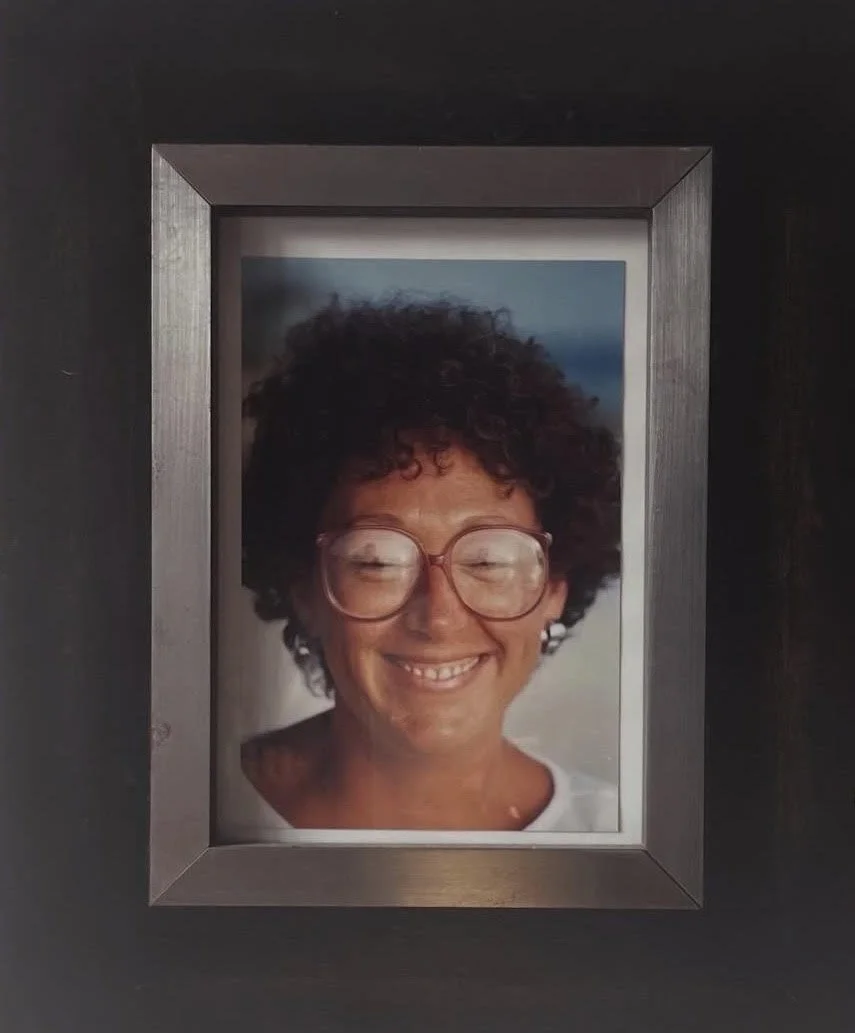
Debbie Ann Richter-Wallace, smiling
The year my mom Debbie turned 49, she told me that every single cell in her body was brand new.
It was based on something she’d heard: the fact that while different types of cells in the body die and renew at different rates, after seven years even the slowest ones will all have been reborn. It’s not true. Some types of cells don’t really regenerate at all, like the ones in the spinal cord and the brain, parts that MS attacks.
But I was seven, and she was seven times seven. From where I stood in the house where I grew up with the lake in the backyard, with the night dark outside the sliding glass doors but the light warm inside our home, it all made perfect sense.
I remember her telling me that she wanted to write a memoir about her newness, called “The 49th Year.” And I don’t remember this part, but she wanted to write it together, and we did, for a little while. My mom sent an email about it to her best friend, Mary, and she called it our book: Lindsay’s feelings and mine, that’s when I was feeling renewed, hopefully, happy, unchained, peaceful.
If she were alive, she would’ve turned 70 on March 30th, and I guess she’d be brand new all over again. But it’s been seven years since she died, and if every seven years my cells are all brand new, that means there’s not an inch of me left that she touched. Not when she held my hand too tight. Not when she asked me to sit in her lap, and I couldn’t bring myself to. Not when I saw her lying still and dead in a bed she’d complained about for years, her mouth open in that awful way dead people’s mouths are, and I still could not bring myself to crawl in next to her then. So I guess I didn’t touch her then. I guess whatever I’m scared I’ve lost was already gone.
But also, last night I had this dream. Just now, really.
Mom is in a room by the water. It’s spacious and simple, nice and clean. She’s in a hospital bed but there are wood floors, and big open sliding glass doors, and sunshine. The water is right there, like she’s on a dock beside it or like the whole room is floating. The sunshine is so warm, it’s golden in the room and glittering on the water. She’s looking out at it. I can only see Mom, but I know somehow that Mary is there, too. And my dad.
It’s like she’s being filmed. I’m watching it like a home movie. And Dad is there but he’s also somewhere else, later, narrating for me.
And I see her just waking up. Her hair is big and curly and full of life and it has the sun in it, and she wakes up and looks out at the water and has the sun on her face, too. I can’t see her face right away but then I can. She’s smiling so big. And, she looks sad.
And my dad, as this later narrator, says, “You know what she did that morning? She woke up and took her medicine, like she did every day.” And in the memory, in the video, she’s taking medicine. And she’s laughing as she does it, kind of sheepish, and I still can’t see Dad and Mary but they’re laughing with her. And then I’m laughing too, in the later, and I’m saying, “Why would she take her medicine?”
And there’s some omniscient dream understanding, the kind that doesn’t make real sense at all, that this is the beginning of the pandemic, and maybe that’s why this is possible, for her to be in this place and do things this way. And in this dream reality she doesn’t lose so many of the people closest to her and she doesn’t get sick in the way that she did. She lives the same amount of time, or I guess a little longer actually, because in real life she died three or so months before we first really heard about Covid. But in this life she gets to keep these people at her side, and in this life the way she gets sick is different. It still leads her here, to the end, but it’s different. She chooses this. She’s holding a cup herself. She can do that.
And then she’s drinking something from the cup and smiling but also crying and there’s so much sunshine on her face but it’s also in shadow, partly. She looks so beautiful. Her smile is so big.
And I can understand that this is different from the medicine she took right when she woke up, which was what she takes every day and that’s why it’s so silly that she took it today. Because now this drink is what’s going to kill her, and she’s drinking it on purpose and in this life she came to this beautiful place with a man she loved and her best friend to die on purpose.
And then the dream flashes and changes and she’s in a bathing suit, a fun orange bikini, like she was just swimming or she’s about to be. She’s standing on a big deck, high up, overlooking a pine forest and a big sparkling lake down below. And other people are there too but she doesn’t care, and she’s the only one in a bathing suit but she’s not self conscious, and they’re not really looking at her anyway. But she knows she’s being filmed and so she’s hamming it up for us, for the camera, a little bit. At first she’s facing away from us and looking down at the water, and then she’s turning around and making some silly faces and holding her arms out wide with her hands open like starfish, like this one photo of her I love on the dock at our house on Dogwood Lane.
I can feel how happy she is. She’s laughing, light and delighted, like she’s on vacation. And somehow I know that now, she’s dead.
I don’t know how I’m seeing her. But I say to Dad, “I should have been there.” And I’m crying so much. This part feels the same as it always has. “Why wasn’t I there?”
And then it’s like I’m starting to wake up, I kind of understand again that I’m in the room in my dad’s basement, in bed in the dark. But it still feels like I’m talking to him too, and it still feels like I just saw her, and it still feels like this is how it happened. And then I’m really awake, and I’m here and I remember.
It’s been seven years since they cremated her after some number of days, I don’t know how many, we can say seven. And her ashes are in different places—my apartment, the cemetery, with her sister Angela in North Carolina. I’m overwhelmed, right now in the room in the basement, by how inert cremation makes a person. I’ve never thought about it like that before. And so I guess in that way every part of her is exactly the same, and in another way every part of her is gone.
So she can have a new death, maybe. In the sunshine by the water with the two people she loved most before she met me. Before she had to worry about me when she decided whether to be alive. She can wear a bikini by a lake in what I know for certain is supposed to be some version of heaven.
I want this to be true so badly. For a moment it felt possible, like a way I really can understand the world if I choose to. It felt possible that now, especially after seven years, every part of her could be new including the way she died. It was something I could believe.
But right now I don’t feel that way anymore and the reality of her death presses in on me again and it’s the deepest, angriest, most helpless sort of sorrow. Panicky and claustrophobic, the way I know she felt for years before the end. It’s sad in my bones, furiously wrong all the way to the marrow. It’s sad in every cell whether they’re new or not. It doesn’t matter how many times they divide and die and are born and die again. They remember. It feels like they will always remember.
Even in this dream, in this new life where she died in the sun, why wasn’t I there? How could I overwrite reality to choose something so nice—only to lie to myself, right? To grant myself some unearned absolution.
But I’m also thinking about that pervasive sense of peace I could feel that she felt, in that room by the water with the sun glimmering and the light all miraculously warm and gold. And the silliness that was there on the deck overlooking the lake, that she got to keep, that never curdled.
I’m thinking about the conversation my dad and I had in the car earlier, after he picked me up from the train station and we went to get Chinese food and then we sat in the driveway for a while.
He said that, for him, as time passes, people’s faults fade and the good things about them remain. “It’s like that saying,” he says, “your strengths are written in stone on the wall and the bad things about you are written in sand on the beach and they wash away.” I’ve never heard this saying. But I get it.
I tell him that I try, with Mom, to think about it that way. To remember that no moment is more important than any other moment. But when a life ends so painfully and so slowly, it’s hard not to think that those moments matter a lot.
And he says he understands. He doesn’t mean the way she died, but who she was. And I understand: he remembers how she was silly and sweet and playful, more than how she could be vindictive or unreasonable or nasty. He remembers when they were in love.
I don’t try to clarify, but I already understood this. I never meant that I thought I could remember a good death for her, through sheer force of will.
But there was a moment when it turned out I could, and that moment is still real. When I first woke up the dream felt like a memory coming into focus, like when you finally recall a word you’ve been searching for, or you look at one of those magic eye patterns just right and suddenly something exists that didn’t before, and it’s so clear. The rightness rang through me because this, something like this, is what she deserved. The moment when I could believe in this dream, in this death. It’s not less important than this moment, now, when I can’t.
I don’t know about all this. I’m trying this thought on, I’m trying to decide how it fits. If I can do it. If I deserve to. If there is something to be said for holding onto how much the end hurt us both, as a way of holding onto her. If how she died is really about what I do or don’t deserve at all.
I know this: she deserved to laugh by the lake, warm in the sun, knowing that people who loved her were watching. Renewed, hopefully happy, unchained, peaceful. Her death is part of her life, how it was and how we both wish it could’ve been. And it’s not more important than all the times she was in the sun, her smile so big.